This page describes the following concepts:
- Processes, Run & Actions
- Distributions
- Actors
Processes, Runs & Actions
Wikipedia describes a process as follows:
A process is a series or set of activities that interact to produce a result; it may occur once-only or be recurrent or periodic.
Below, the description of a process and a run related to Forms and Flows is given.
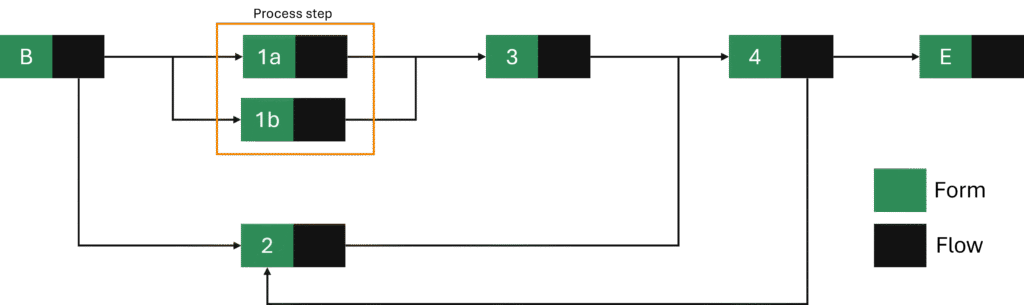
A process is a definition containing metadata, activities and the relationships between activities.
An activity consists of a action (a form) and an automation (a flow).
A process always has a begin activity and an end activity.
Activities are grouped into process steps. A process step can contain one or multiple activities. An activity always belongs to one process step.
The image shown below is a visualization of an example process that can be automated with Forms and Flows.
A run is an instance of a process, or otherwise said, an actual execution of a process.
As an analogy, one can say that a process is a recipe and a run is an actual baking of that recipe.
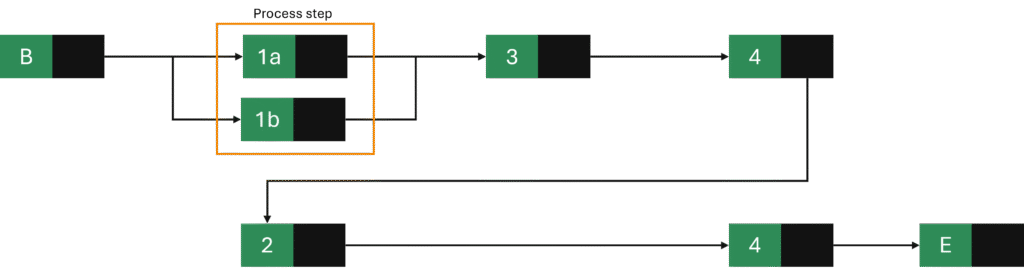
When a run has ended, it has travelled one of the possible paths through the process.
The image shown below is a visualization of a possible path travelled through the example proces. In this example, activity 4 has been executed twice.
A run is a collection of data and the actual execution of activities, meaning the actual submission of forms (the execution of actions) and the flow runs (the execution of flows).
A run does not have to include all activities defined by the process and activities defined by the process can be executed multiple times.
Submitting a form kicks of the related flow.
A form can be submitted manually or automatically.
An form is based on a form definition like the fields to include, their order and the checks to perform on these fields.
Actions are always unique, even if they are based on the same action template.
Distributions
The UPAM together with a technology stack are the basis for a distribution.
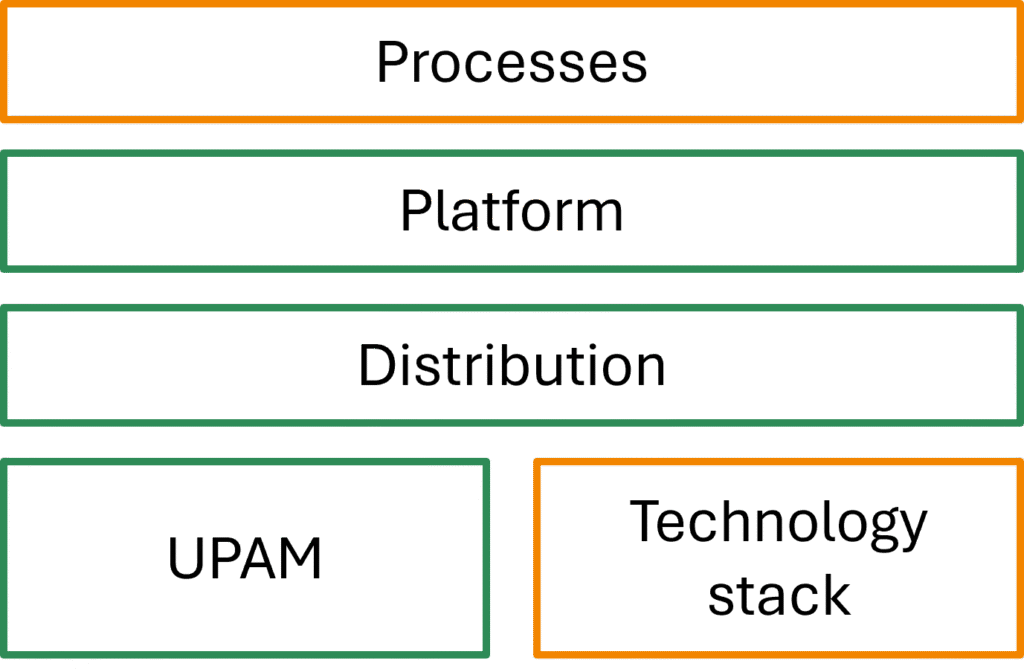
A distribution is the actual realization of Forms and Flows as a product, offering a process automation platform.
Because a distribution is technology stack dependent, it has its own specific implementation.
There are official, approved and third party distributions.
Official distributions are offered via this website.
Approved distributions are distributions built by others which have followed an approval process. Links to approved distributions are offered via this website.
Third party distributions are built by others and not offered via this website.
The makers of approved and third party distributions must describe if and how their distributions comply to the Universal Process Automation Model (UPAM).
Actors
An actor is a specific type of user of the process automation platform. There are 3 types of users defined:
- End users
- Process managers
- Application managers
End user
And end user can start a run and is involved in the execution of actions.
Process manager
A process manager:
- manages one or multiple processes.
- has access to all data related to all her processes.
- has specific process related functionalities.
Application manager
An application manager:
- can manage all processes.
- has access to all data of all processes.
- has specific platform related functionalities.
- has specific process related functionalities.